Table of Contents
In India, most people usually approach traditional banks or NBFCs (Non-Banking Financial Companies) when they need money for personal needs, medical emergencies, business expansion, or other financial requirements. However, loan applications are sometimes rejected due to reasons like insufficient documents, a low credit score, or limited income. This is where the Best P2P lending platforms in India come into the picture as a practical alternative.
P2P lending platforms directly connect borrowers with individual lenders through an online marketplace. This makes it possible for people to access funds even when banks are unable to approve their applications. Through a P2P lender, you can raise money for various purposes such as education, business growth, personal emergencies, or even debt consolidation. In this article, we will explain what Peer-to-Peer lending is, how it works, the key benefits of borrowing through a P2P lending platform, and list of the best p2p lending platforms in India registered under RBI.
What is Peer-to-peer lending& how does it work?
In general, Peer-to-peer lending can be described in a single word as crowdfunding or social funding. They connect each individual borrower & lender directly and cut out the intermediate traditional bank as a middleman.
In simple words, there are three major components of Peer-to-Peer lending: Lender/ Investors, who invest their money in exchange for high return; Borrowers, who lend money directly from those investors; and the P2P lending platform, which can be an application or a website.
Today, many of the best P2P lending platforms in India are making this model more accessible and efficient for users.
Usually, investors open their accounts in those P2P platforms deposit a lump sum amount, and allow it to be distributed as a loan.
On the other side, when a person applies for a loan through these P2P lending platforms and puts his financial profile, based on his creditworthiness, the loan will be approved.
But in this case, only the P2P lending platform has the authorisation to evaluate the creditworthiness of the borrower and decide the loan interest, loan tenure, repayment process and other terms & conditions.
This structured approach is one reason why some of the best P2P lending platforms in India are gaining popularity among both investors and borrowers looking for alternative financial solutions.
Unlike traditional banks, they are not strict on a high credit score. They evaluate a borrower’s loan eligibility on various parameters like employment, net salary, dependency, banking transactions, and other investment plans.
In fact, by using their technology, a P2P platform can also capture borrowers’ repayment activities, app usage, etc.
As a new borrower, P2P lenders may offer a small amount of loans at an initial stage. Based on the borrower’s repayment habits, they can agree to approve a higher amount with more flexible terms & conditions. Quick loan application, underwriting and approval process made a P2P lending platform more convenient to borrowers.
If you’re hunting for the best p2p lending platforms in India, you’ll notice many prioritise speed: quick applications, faster underwriting and rapid approvals make P2P lending a convenient alternative for borrowers who don’t fit the traditional credit mould.
How is P2P lending regulated in India?
The regulation of P2P lending platforms is governed by the Reserve Bank of India, by defines P2P platforms as NBFCs under section 45I(f)(iii) of the RBI Act, which states that an NBFC registered under RBI can operate their business as a Peer-to-Peer lender.
As of January 31, 2022, there are 25 NBFC-P2P companies registered with the RBI, operating their businesses in the metropolitan cities of India, including Bengaluru, Chennai, Mumbai, and New Delhi.
Many of the best p2p lending platforms in India fall under this regulatory framework, ensuring safer, more transparent lending practices.
In addition, the P2P lending platform should be a member of all CICs in India (TransUnion CIBIL, Experian, Equifax, and CRIF Highmark) and report each borrower’s repayment history every month or at a shorter interval. And the loan tenure shall not exceed more than 36 months.
As per the RBI guidelines, every NBFC P2P should have an internal grievance redressal mechanism to handle the customer’s complaint.
If the complaint is not redressed within a period of one month, the customer can appeal to the Customer Education and Protection Department of the Bank.
Benefits of Peer-to-peer lending:
- Peer-to-peer lending platforms, especially the best P2P lending platforms in India, primarily cater to individuals who are ineligible to secure loans from traditional banks or NBFCs.
They may consider the average credit score (650- 750) of a borrower in exchange for a slightly higher interest rate than the traditional banks.
The best thing about the P2P lending platform is that they have no strict eligibility criteria or documentation required. The platform confirms all details at the time of registration.
2. For Borrowers who are looking for a small amount for short periods (up to 36 months), peer-to-peer lending (with the microfinance model) can be the most suitable option for them.
3. With the aid of technology, loan processing is very fast & hassle-free. When a borrower registers on a P2P platform and enters their required financial details, they will instantly connect with a lender on the platform.
Unlike traditional banks, they have no expenses for physical branches or office staff, which reduces the overall service charges.
4. As most of the peer-to-peer lending platforms are application-based or operate through their websites, this makes it more accessible for all people around India.
Key points to be checked as a borrower before choosing a Peer-to-peer lending platform:
- Check their official website or the application and verify the reliability before borrowing.
- Ensure that the P2P lending platform is registered in RBI under the NBFC-P2P Act 2017.
- When exploring the best p2p lending platforms in India, don’t rush; spend more time researching the website. Compare the loan interest, terms & conditions and choose the best deal for you.
RBI Registered best p2p lending platforms in India:
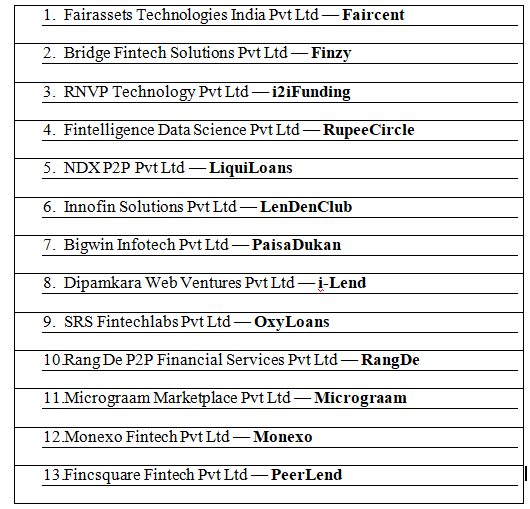
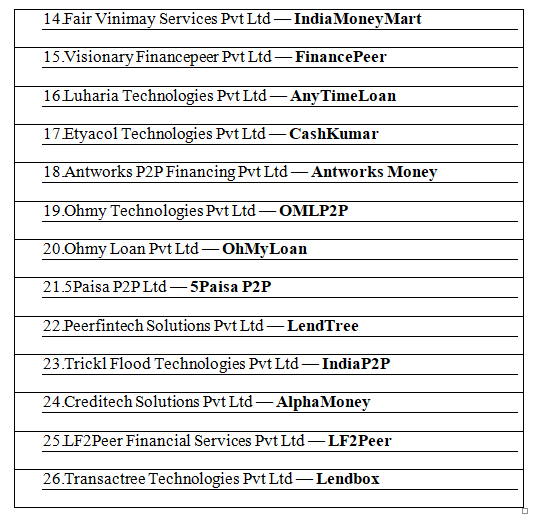
As of March 2024, around 26 NBFC-P2P companies are registered with the RBI. Below is a commonly referenced list of RBI-registered P2P lending companies in India (company name with platform/brand):