
Table of Contents
When you are dealing with loans or credit cards, you sometimes come across certain words in your CIBIL report that feel a bit confusing, almost like they’re not for normal humans to understand. One such label is Post Write-off Closed in CIBIL. Getting the meaning right matters because it can influence your credit health and also how easily you can borrow later on. Let’s break it down in a more down-to-earth way, so the effect of Post Write Closed in CIBIL becomes clearer and less scary.
Understanding CIBIL and the idea of “Post Write-off Closed in CIBIL”
The Credit Information Bureau (India) Limited, which people usually call CIBIL, is one of the main credit bureaus in India. It keeps track of how you’ve dealt with credit, like loans or credit cards,and the way you repay over time, kind of in a chronological manner so lenders can see the pattern. Banks and financial institutions use your CIBIL score as one of the key signals, to decide whether they should approve new credit.
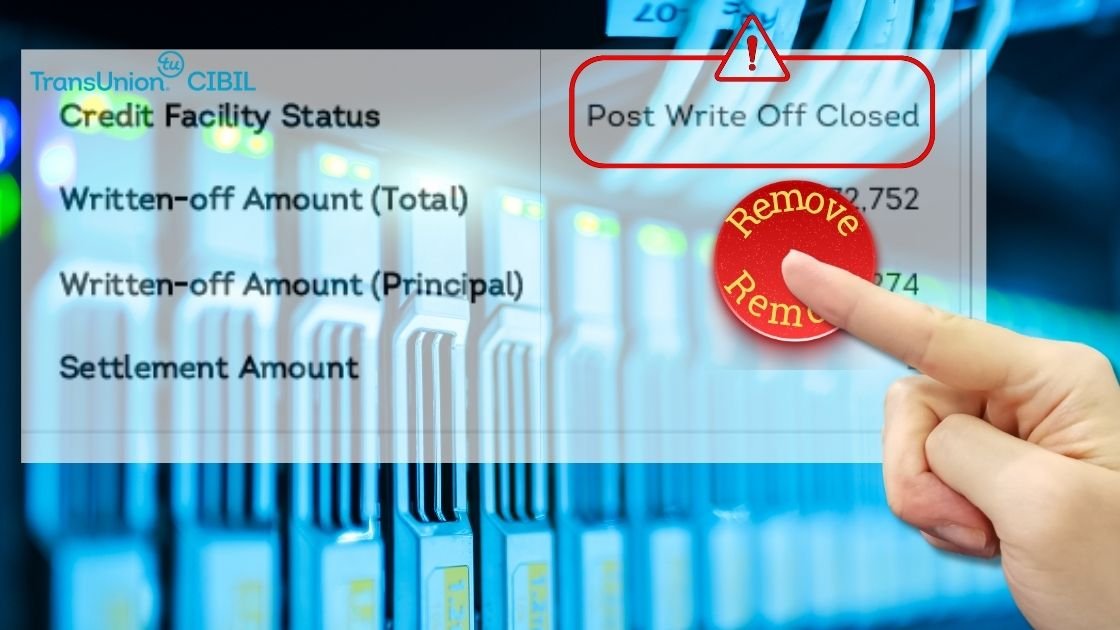
Now, a Post Write-off Closed usually reported, when a lender pays the entire outstanding amount, when the credit facility was reported as NPA (Non Performing Asset) especially written off from their Asset books.
Meaning of Post Write-off Closed in CIBIL
The phrase Post Write-off Closed in CIBIL can show up in your credit report when something like this happens:
- Your lender first treated the dues (loan or credit card) as a loss, which means they wrote it off.
- Later, you manage to repay or settle the full outstanding amount with the lender.
- After that repayment, the lender updates the account state to “Closed” in your report, once the settlement is done.
In simple terms, it suggests the account was seen as not recoverable at first. But later, you actually cleared the amount, and the lender chose to close the file.
Post Write-off Settled vs Post Write-off Closed in CIBIL (the difference)
These two labels get mixed up a lot, so here’s the clearer separation:
- Post Write-off Settled: You paid only part of the dues, and the lender agreed to accept that amount, while the remaining balance was waived.
- Post Write-off Closed: You paid the full outstanding dues, and the lender closed the account without forgiving a remaining amount.
From a credit score point of view, Post Write-off Closed is generally viewed more positively than the word “Settled,” because it points toward complete fulfilment rather than partial acceptance.
Impact of Post Write-off Closed in CIBIL
Even though “Post Write-off Closed in CIBIL” sounds better than “Settled,” it still has a shadow effect:
- Negative history stays on the report: The fact that the account was once reported with Post written off closed, remains visible for lifetime or until RBI implements any new guidelines about that.
- Score improvement can happen gradually: Closing the account after repayment can help your score rise over time, but it doesn’t instantly erase the earlier damage.
- Future borrowing may still be tougher initially: Some lenders may still treat you as higher risky borrower.
Does the status “Post Write-Off Closed” matter?
This status is important mainly because:
- It shows lenders that you eventually took responsibility and repaid the debt.
- It supports your rebuilding process with banks and financial institutions.
- It can improve your long-term credit profile, rather than leaving the account hanging unresolved.
How to manage accounts marked Post Write-off Closed
If you see this status in your CIBIL report, consider these practical steps:
- Check your CIBIL report regularly, and confirm the update is correct and complete.
- Keep all your current credit obligations on time, like EMIs and credit card payments, consistently.
- Try not to settle unless it’s truly unavoidable. In general, “Closed” tends to be more favourable than “Settled,” because it indicates full repayment.
- Follow up with the lender if reporting looks wrong, so they update the closure details properly in CIBIL.
Example scenario (to make it easier)
Imagine you had a credit card with ₹50,000 still due, like in the balance. After some serious money stress, you stopped paying for a while, and then the bank kind of decided to write off the dues, you know, because things got out of hand. Then, after about two years, you manage to repay the full ₹50,000.
The bank later closes the account and updates your CIBIL report to show Post Write-off Closed. The message behind that update is basically: yes, it looked difficult initially, but the debt was fully repaid, and the account was closed.

Final thoughts
Post Write-off Closed in CIBIL is really a story of sorts—from financial difficulty to eventual repayment. While you should always aim to clear dues rather than leave things unresolved, the good part is that repayment followed by “Closed” can help you rebuild credibility.
With steady financial discipline over time, your credit score can recover, and lenders are more likely to see you as someone who follows through.
Q & A:
- Can you remove post write-off closed from CIBIL?
Ans: As the Post Write-off Closed is implemented by RBI for the accounts that were in NPA (Non-Performing Asset) status in the records of lender. You cannot remove that, though some of the lending institutions are still removing that when you approach them in a proper way.
- What is the difference between Post Write-off Closed & Post Write-off Settled?
Ans: Post Write-off Closed means, you have paid the entire outstanding amount to the lender, after it was in NPA. And Post Write-off Settled means you have paid less than the entire outstanding amount.
- Should I raise a dispute to remove Post Write-off Closed in CIBIL?
Ans: Yes, you can but the resolution of that dispute might not be in your favour, as the rights to change the status is only authorised to the financial institution.